
RCNP receives €2.4 million grant from John Templeton Foundation on Origins of Irreversibility
In June 2026 the RCNP received great news: the application to the John Templeton Foundation for an enormous grant was succesful! The application was led by PI Manus Visser and co-PI Klaas Landsman, together with Kian Salimkhani and Marij van Strien. The title of the project is Origins of Irreversibility. The grant will allow for two new PhD students and four postdocs, as well as conferences, summer schools and visitor programmes.
The project starts in December 2026 and runs until August 2029, and will involve ten researchers and aims at developing a unified understanding of irreversibility, entropy, randomness, and chaos. The researchers will approach the problem from three closely connected directions. First, they will investigate how irreversible behaviour can emerge from complex microscopic dynamics. Using modern mathematics, they aim to make ideas such as Boltzmann’s powerful but puzzling idea of “molecular chaos” more precise and to determine how microscopic randomness can lead to predictable large-scale behaviour.
Second, the team will study irreversibility in the most extreme physical systems in the universe: black holes. As first recognized by Stephen Hawking and Jacob Bekenstein in the early 1970s, black holes behave in strikingly thermodynamic ways: they can be assigned entropy and temperature, while the area of their horizons can only increase. This was one of the most spectacular developments in fundamental physics in the second half of the twentieth century, of which much remains to be understood. The project will investigate how this thermodynamic behaviour of black holes works both mathematically and physically, the latter especially when black holes are changing and out of equilibrium. The third strand examines the historical and philosophical foundations of concepts such as chaos, randomness, entropy and coarse-graining. A central question is why simplified, large-scale descriptions such as thermodynamics can nevertheless provide reliable, objective accounts of the physical world.
The project is led by Manus Visser and brings together other Radboud researchers including Klaas Landsman, Marij van Strien and Kian Salimkhani. The grant will support four new postdoctoral researchers and two new PhD candidates, international research visits, workshops and conferences, as well as public-facing activities. By combining disciplines that often approach irreversibility separately, Origins of Irreversibility ultimately seeks to understand why a universe governed by reversible laws produces a world in which so much change appears impossible to undo.
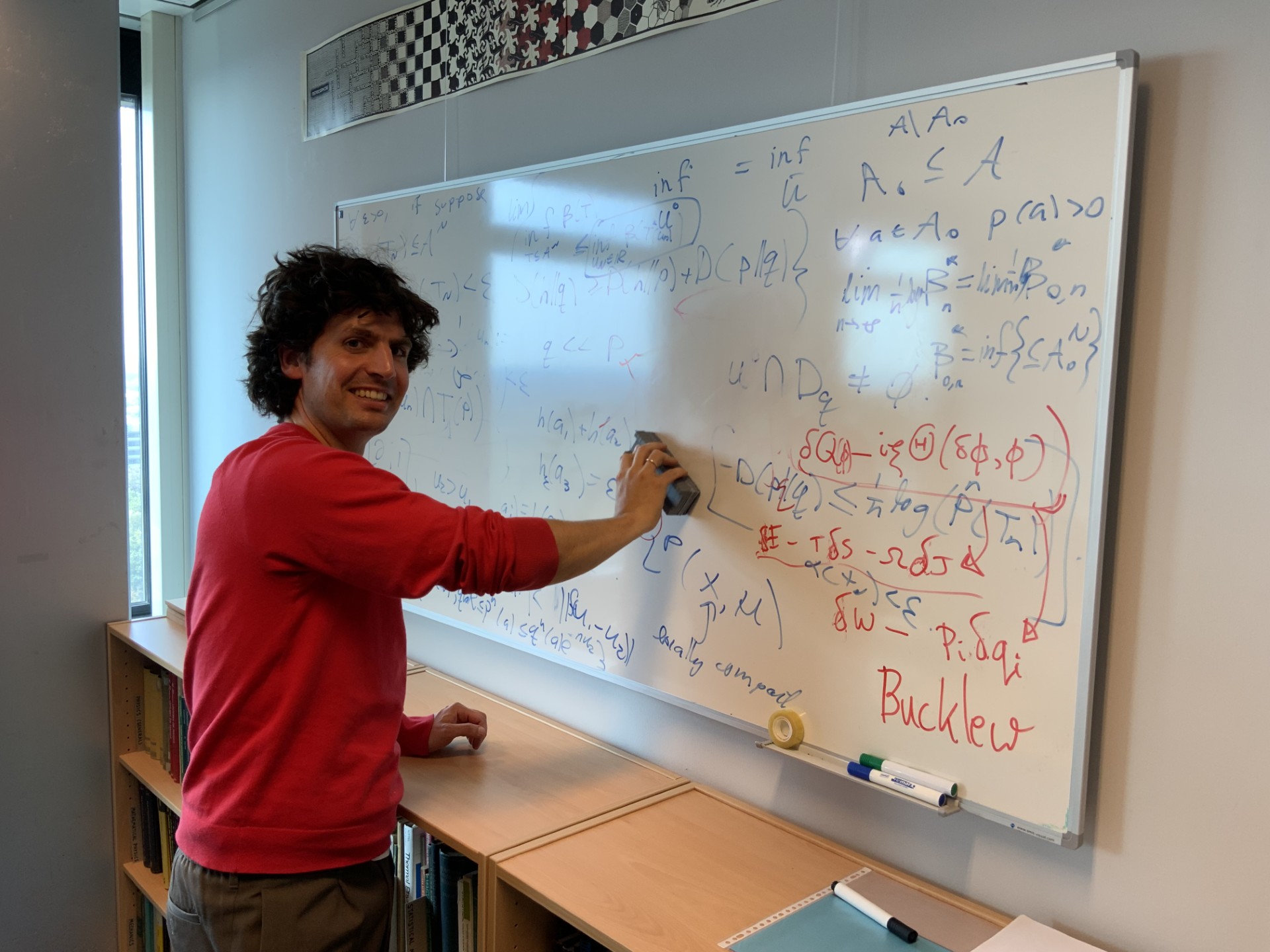
PI Manus Visser performing an irreversible action.